Key facts at a glance
- AI in job applications is normal in 2026: depending on the study, around four in ten to almost half of all applicants use tools like ChatGPT, mainly for their CV, cover letter and answers in application forms. It isn’t forbidden. What matters is how you use it.
- AI is good at analysing job ads, polishing your language and practising job interviews. What you have experienced and why you are applying are questions it can’t answer for you.
- Cover letters generated entirely by AI can look professional at first glance, but they lose persuasive power when concrete examples and a real link to the job are missing.
- The most important content has to come from you: your experience, your motivation, your examples and your link to the job. The AI may structure, shorten and improve the language.
- Check everything the AI writes: it sometimes makes up facts, figures or wording that doesn’t fit you. Whatever is in your cover letter, you have to be able to stand behind in the interview.
- Don’t enter sensitive data into AI tools: before pasting, you can black out names, addresses and confidential details or replace them with placeholders.
AI in job applications: the norm, not an insider tip
Only two or three years ago, people talked about it in whispers. Today it’s everyday life: depending on the study, around four in ten to almost half of all applicants use AI tools like ChatGPT for their application documents, especially for CV text, cover letters and answers in application forms. Companies are also using AI more often, for example to pre-sort applications, to analyse documents or in digital selection processes.
So the question is no longer whether you’re allowed to use AI. The question is how to use it so that your application gets better, not more interchangeable. Writing a job application with ChatGPT can be helpful if you use the tool as a thinking partner, not as a replacement for your own decision about what you want to show.
Good to know: Companies also have to be careful when they use AI in recruiting. In the EU, AI systems used in applications and employment are considered particularly sensitive. So you don’t have to adapt to a completely opaque machine. Still, clearly structured documents that fit the job help people and software alike.
ATS, AI and your CV: what’s the difference?
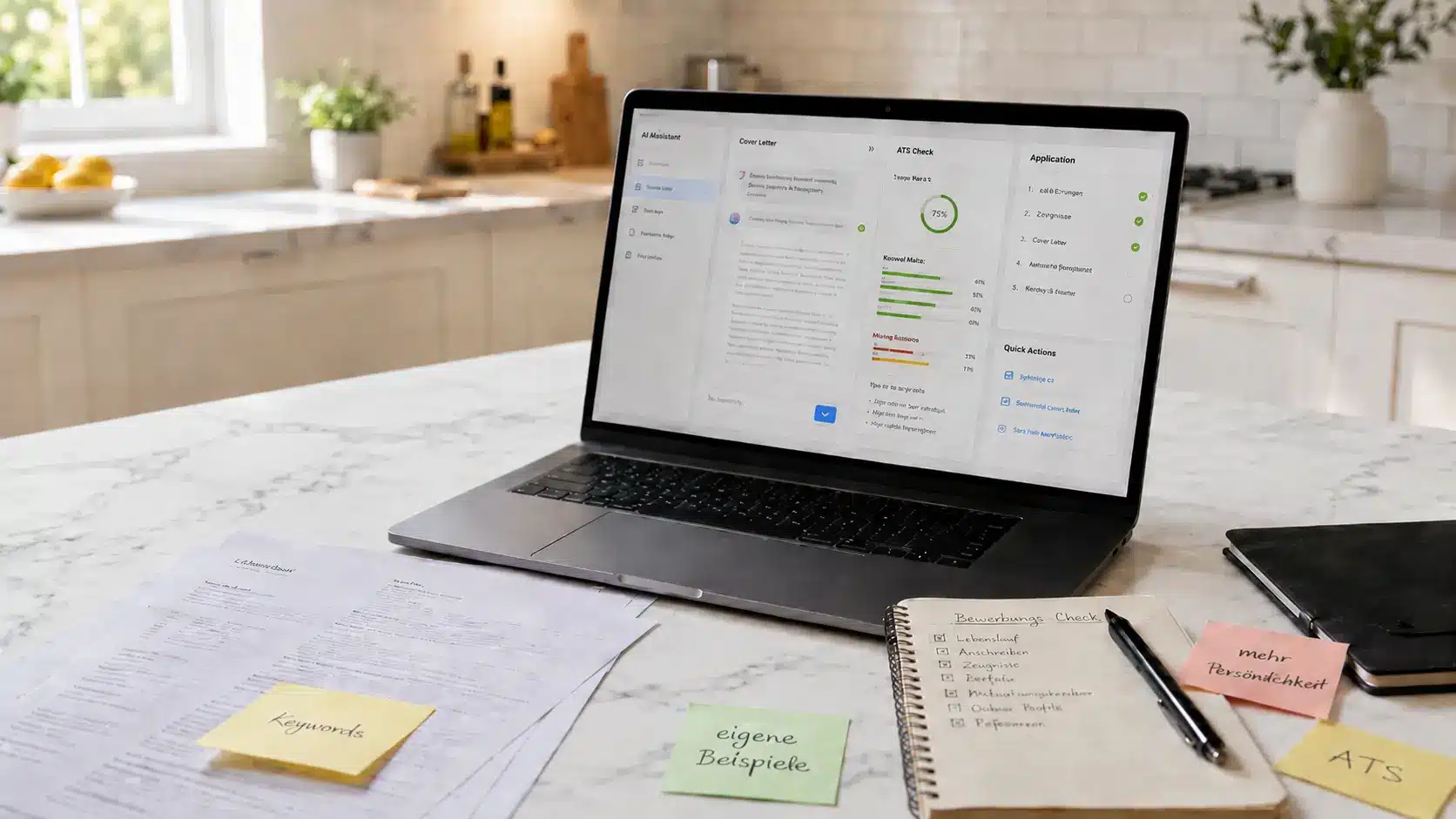
Many people lump ATS, AI screening and ChatGPT together, but they are different things. An ATS (Applicant Tracking System) is first of all applicant management software that companies use to collect and manage applications. Some systems work with automated filters or AI functions, others don’t.
For you, this means your CV should be easy to read, for people and for software. Use simple headings like “Work experience” (Berufserfahrung), “Education” (Ausbildung) and “Skills” (Kenntnisse), avoid complicated tables, icons or purely graphic elements, and pick up important terms from the job ad naturally. The point isn’t to trick a system. It’s to make your relevant experience easy to see.
Where AI really helps you
1. Analysing job ads
Copy the job ad into the AI tool and have it pick out the most important requirements and key terms. This shows you at a glance what the company values, so you can respond to it specifically. It is also the basis for an ATS-friendly CV.
2. Improving your own draft
The strongest use: you write it yourself first, imperfect but honest. Then you let the AI smooth out the language. That way the content stays yours, and the AI is only the editor. You’ll find a ready-made prompt for this further down in the prompt examples.
3. Shortening and structuring
In many application processes, short, clear cover letters work better today than long standard texts. As a guide, 250 to 350 words are often enough, as long as your motivation, your link to the job and concrete examples come through. AI is excellent at getting a text that’s too long to the point without losing content.
4. Practising job interviews
Have the AI ask you typical questions for your target position and practise your answers in a dialogue. The AI can follow up like a recruiter. You can read which questions almost always come up here.
5. Simulating an outside view
Ask the AI to read your documents from a company’s point of view: “What would a recruiter see critically in this CV?” It doesn’t replace honest feedback from another person, but it often shows points that are easy to overlook yourself.
Where AI harms your application
The generate-everything mistake
“Write me a cover letter for this job” is the most common mistake, and the one with the biggest consequences. The result sounds fluent but is interchangeable: the same wording, the same enthusiasm, the same phrases as in a thousand other applications. Whether a text was written with AI or not often doesn’t matter much. If it stays too general, it doesn’t stand out from the many other applications.
In German, AI texts often seem artificial in certain places: very smooth transitions, lots of enthusiasm without a concrete example, interchangeable wording and sentences that sound correct but say little.
Made-up facts
AI tools sometimes invent details: a qualification you don’t have, a figure that’s wrong, a project that never existed. That’s embarrassing in an interview, and as false information it can even have consequences under employment law. So check every sentence. Whatever is in your cover letter, you have to be able to talk about without hesitation in the job interview.
Data protection
Don’t enter sensitive data into AI tools. This includes:
- full contact details and dates of birth
- names of referees or managers
- salary details and internal project information from former employers
- employment contracts, job references or official notices as unfiltered uploads
Replace such details with placeholders (“[Name]”, “[Company]”) before pasting, and only put them back in the finished document.
The personal story is missing
The biggest problem is the least visible one: AI doesn’t know your story. It doesn’t know why you are coming back right now after parental leave, what really attracts you to this company or which experience has shaped you. In the end, it’s these personal details that bring an application to life. AI can help you put them into good words. But what makes you who you are, you have to bring in yourself.
The best way to go about it:
the 4-step workflow
- Analyse: Give the job ad to the AI and have it pick out the requirements and key terms.
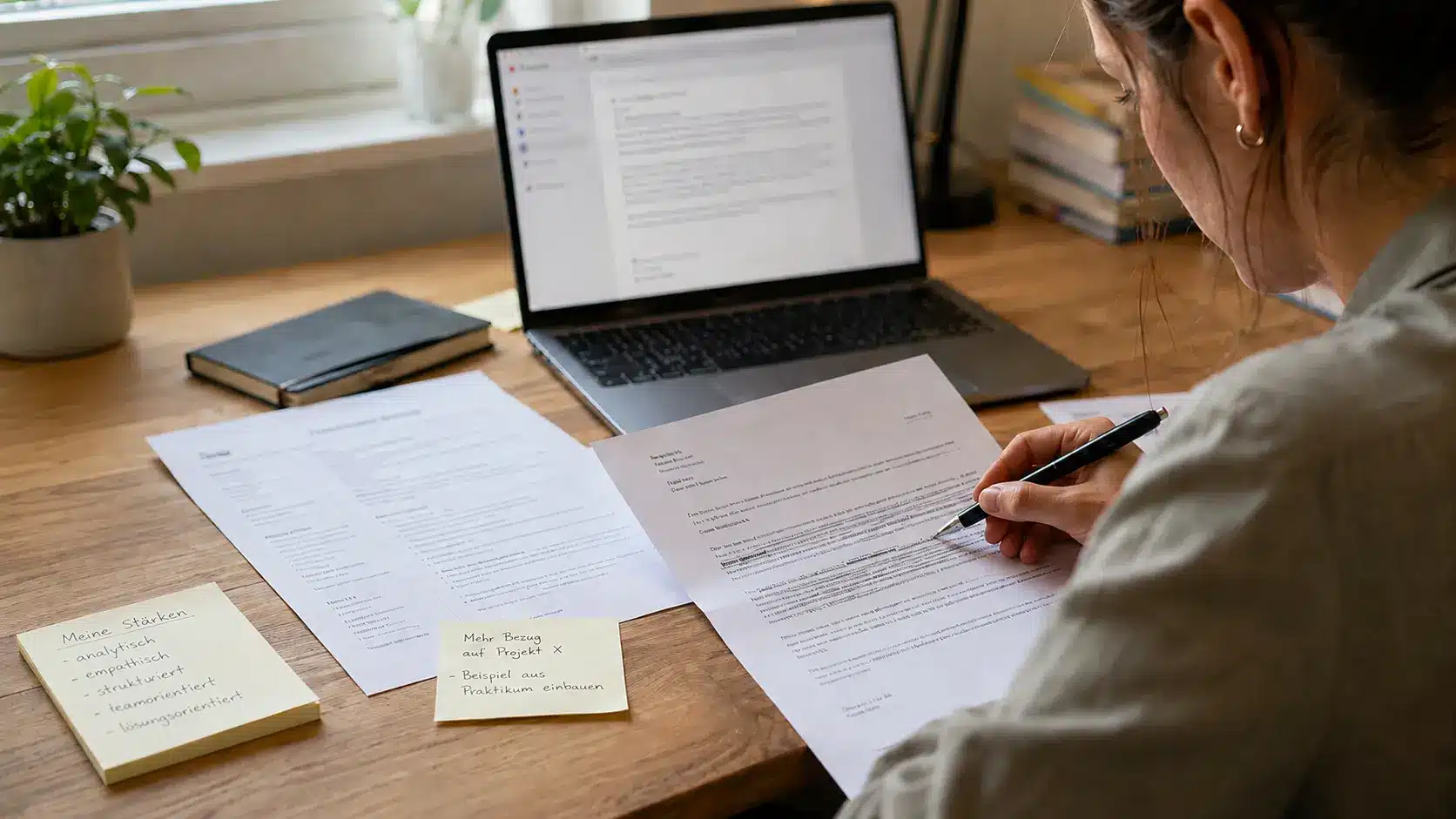
- Write it yourself: Write your rough draft yourself, with your motivation, your concrete experience and your link to the job. The most important content comes from you; the AI may structure and improve it later.
- Have it refined: The AI smooths the language, shortens it and naturally works in the most important terms from the ad, with the clear instruction not to invent anything and to keep your style.
- Check it and make it personal: Read everything for accuracy, delete AI clichés, add at least one concrete detail that only you could write. Only then send it.
Three prompt examples for your job application with AI
Prompt 1: Analyse the job ad:
“Analyse this job ad. List the most important requirements, must-have criteria, nice-to-have criteria and recurring key terms. Then create a short overview of which experience from my CV would be particularly relevant. Don’t make anything up.”
Prompt 2: Improve your cover letter:
“Revise the language of my cover letter. Cut empty phrases, make it more active and clearer. Keep my concrete examples, my tone and my statements. Don’t add any new facts.”
Prompt 3: Check your application critically:
“Read my application from a recruiter’s point of view. What is convincing? What remains unclear? Where are concrete examples missing? Which sentences sound generic or like AI?”
How we support you
Sometimes the writing itself isn’t the problem, but the question: what actually makes me who I am? If your CV doesn’t feel coherent yet or your applications go unanswered, we help you work out your strengths, experience and goals more clearly, for example in AVGS coaching, in academic coaching or in psychosocial coaching under Section 16k SGB II. We look forward to your message.
Frequently asked questions about job applications with AI
Can I write my application with ChatGPT?
Yes, it’s allowed and now very common. What matters is that the content is correct and that you can stand behind it. You are liable for false information, not the tool.
Can recruiters recognise AI-generated applications?
There is no reliable technical detection. AI detectors can give hints, but they are also wrong, especially with short, heavily edited or very formal texts. Experienced recruiters are more likely to recognise generic texts: interchangeable phrases, perfect but empty language, a lack of concrete examples. So what matters is less whether a tool suspects an “AI share” and more whether your application comes across as concrete, credible and suited to the job.
How much AI is okay?
The most important content should come from you: your experience, your examples, your motivation and your link to the job. The AI may structure, shorten and improve the language. Deciding what you show is up to you.
What data shouldn’t I enter into AI tools?
Full addresses, names of third parties (for example referees), salary details and confidential information about employers. Use placeholders and only add the real data in the finished document.
Can AI write my CV too?
AI can help with structuring, wording and the ATS check. But the positions, figures and achievements have to come from you and be correct.
Can I have ChatGPT write my entire application?
Technically yes, but it rarely makes sense. Fully generated cover letters often come across as smooth but impersonal, and they lose persuasive power when concrete examples are missing. It’s better if you provide the examples, motivation and experience, and the AI helps with the structure and the final polish.
Do I have to disclose that I used AI?
As a rule, you don’t have to mention unprompted that you used AI to polish the language. But if a company explicitly states rules on using AI in the application process, you should follow them. In any case, your statements must be true and you must be able to stand behind them.
Does AI also help with gaps in my CV?
With the wording, yes. But how openly you deal with a gap is a decision you should make consciously, by yourself.
Final tip: Read your finished cover letter out loud once, ideally as if you were telling it in a job interview. Any sentence that feels strange to say probably didn’t come from your own head. Replace exactly those sentences with what you would really say. That turns an AI text back into your application.